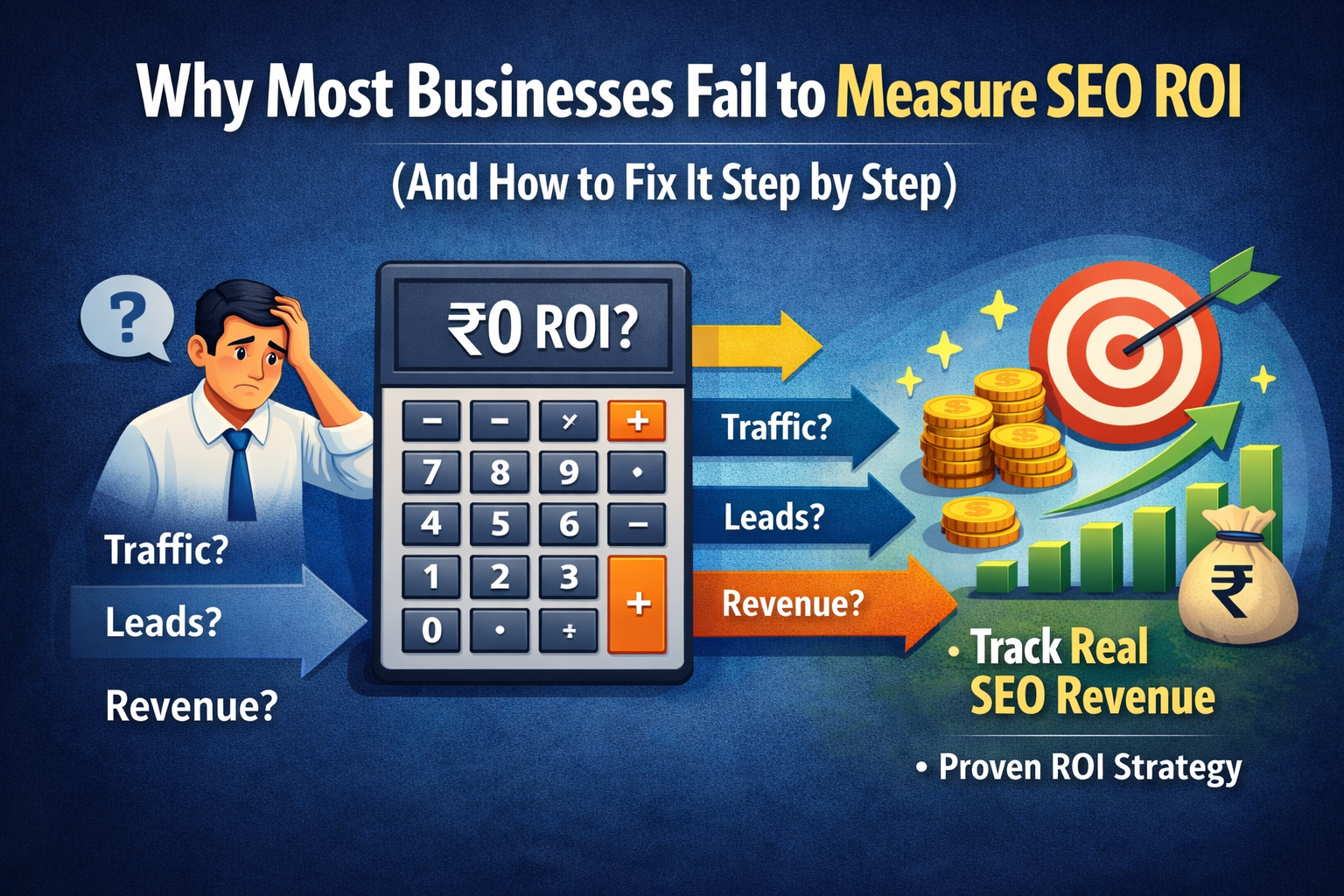
Most businesses invest in SEO for months yet struggle to answer one critical question: How much revenue did SEO actually generate?
The problem is not lack of data. It is flawed attribution, weak valuation models, and unrealistic timelines.
If you already understand keywords, on-page SEO, and backlinks, this guide takes you further. I focus on how to measure SEO ROI in a way finance teams, founders, and decision-makers trust, especially in Indian markets.
Step 1: Stop Defining SEO Success Using SEO Metrics
Rankings, impressions, and traffic are not business outcomes. They are indicators.
SEO ROI only exists when SEO ties directly to:
- Sales revenue
- Qualified leads
- Bookings or enquiries
Before measuring ROI, define SEO’s role:
- First-touch acquisition
- Mid-funnel education
- Conversion support
If SEO mainly introduces users, last-click revenue will undervalue it. Context must come before calculation.
Step 2: Segment Organic Traffic by Intent, Not Just Source
Filtering traffic by “Organic Search” alone hides reality.
In Google Analytics 4, segment organic traffic into:
- Brand vs non-brand queries
- Informational vs commercial landing pages
- New users vs returning users
Why this matters:
- Brand organic captures existing demand
- Non-brand commercial traffic reflects SEO growth
Advanced SEO ROI measurement focuses on non-brand, revenue-intent traffic.
Step 3: Remove Low-Quality Conversions From ROI Calculations
Most analytics setups inflate conversions.
For ROI calculations:
- Exclude micro-conversions like scroll depth or time on page
- Deduplicate calls, forms, and WhatsApp clicks
- Count only actions that can realistically generate revenue
Use Google Analytics to separate analysis conversions from ROI conversions. Mixing both weakens credibility.
Step 4: Calculate Lead Value Using Real Business Data
Assumed lead values destroy trust.
Use historical data instead:
- Average deal value: ₹90,000
- Net revenue after delivery costs: ₹70,000
- Close rate from organic leads: 12%
Value per organic lead:
- ₹70,000 × 12% = ₹8,400
If SEO generates 150 qualified leads in a quarter:
- SEO revenue = ₹12,60,000
This aligns SEO ROI with real business economics.
Step 5: Include Assisted Conversions or Accept Undervaluation
SEO rarely converts users on the first visit.
Common paths include:
- Organic → Direct → Conversion
- Organic → Paid retargeting → Conversion
- Organic → Email → Conversion
Ignoring these paths undervalues SEO.
Advanced teams assign partial revenue credit when SEO appears early or mid-funnel. This reflects how buyers behave in long sales cycles.
Step 6: Stop Undercounting SEO Costs
SEO ROI often looks high because costs look low.
Include all related expenses:
- SEO agency fees or in-house salary allocation
- Content creation and editorial costs
- Technical SEO development hours
- SEO tools and reporting platforms
Example quarterly SEO cost:
- SEO execution: ₹3,50,000
- Content production: ₹1,80,000
- Tools and technology: ₹70,000
- Total SEO cost: ₹6,00,000
Accurate costs make ROI defensible.
Step 7: Calculate SEO ROI Using Defensible Math
Now apply the formula with realistic numbers.
SEO ROI (%) = (SEO Revenue − SEO Cost) ÷ SEO Cost × 100Example:
- SEO revenue: ₹12,60,000
- SEO cost: ₹6,00,000
SEO ROI = 110%
This is conservative, credible, and decision-ready.
Step 8: Validate ROI Using Sustainability Signals
Revenue shows results. SEO metrics show durability.
Use Google Search Console to confirm:
- Growth in non-brand impressions
- Improved click share for commercial queries
- Stable or rising click-through rate
Also monitor:
- Organic conversion rate
- Revenue per organic session
If revenue rises without these signals, attribution may be flawed.
Step 9: Evaluate SEO ROI Over Compounding Time Periods
Monthly ROI snapshots mislead.
For accurate evaluation:
- Compare rolling six-month periods
- Use year-over-year organic revenue
- Track ROI by content cohort
SEO content often peaks months after publication. Long windows reveal compounding returns.
Step 10: Report SEO ROI Like a Business Investment
A strong SEO ROI report answers three questions:
- Is SEO profitable today?
- Is profitability improving?
- Where should we invest more or less?
Include:
- SEO spend in ₹
- SEO-attributed revenue in ₹
- ROI percentage
- One clear trend chart
- One insight explaining movement
Avoid keyword lists unless they explain revenue change.
Final Takeaway
Most businesses fail to measure SEO ROI not because SEO is unclear, but because they measure it like beginners even after gaining experience.
If you already know SEO basics, accurate ROI comes from:
- Intent-based traffic segmentation
- Real lead valuation
- Assisted conversion credit
- Full cost accounting
- Long-term analysis windows
When done correctly, SEO remains one of the highest-return channels for businesses.